-
-
Phone
+86-13623462298



ASME class 600 flanges: prices 2026 from the factory
2026-07-24
- Why is the ASME Class 600 flange market booming in 2026?
- Technical nuances: where are the dogs buried?
- Price analytics: what to expect in 2026?
- Comparison table: Factory vs Reseller vs Import
- How not to buy a “pig in a poke”: acceptance checklist
- Localization and service: Russian context
- Future of the market: forecasts and concerns
- Conclusion: final verdict
Let's be honest: if you're looking forflanges ASME class 600with current prices for 2026 directly from the factory, you are most likely already tired of endless calls to managers who themselves do not know the difference between ASTM A182 F316 and ordinary “three hundred and sixteenth” steel. The market is oversaturated with offers, but 90% of them are either resellers with a 40% markup, or warehouses with the remnants of Soviet GOST, repainted to the American standard. In this article, I will not spill the beans about “digital transformation.” We will talk about why the cost of one flange in Moscow can differ three times from the price in Chelyabinsk, what hidden casting defects are now emerging en masse in batches of 2025, and whether it is even worth contacting new suppliers from Asia in the current ruble exchange rate.
Why is the ASME Class 600 flange market booming in 2026?
The situation on the high-pressure pipeline fittings market has changed radically. Just five years ago, an engineer could simply open a catalog, select the desired diameter and order a batch. Today's purchaseflanges ASME class 600turned into a minefield. Why? Because the 600 class is not just “thick metal.” This pressure is up to 100 bar (depending on temperature and material), this is a responsibility where an error in the chemical composition of the steel threatens to depressurize the line.
In 2025, we are faced with an interesting phenomenon. Large Western manufacturers, such as Bonney Forge or McWade, have actually left direct access for Russian small and medium-sized projects. Official distributors have disappeared. In their place came players from China, India and Turkey, as well as domestic factories trying to replace imported products. But here's the problem: not all of them know how to do ASME correctly.
Many people think that ASME is just a marking. Deep misconception. This is a quality control philosophy. When you see a price that seems too good to be true, you know that somewhere you saved on heat treatment or reduced the molybdenum content in the steel. I have personally seen certificates where the numbers were falsified so carefully that they could only be distinguished by spectral analysis in the laboratory. And these are not isolated cases.
Factor of the ruble exchange rate and logistics
Prices in 2026 are formed under the pressure of two gigantic factors: the volatility of the national currency and the complication of supply chains. If the plant operates on imported raw materials (and high-quality alloy steel is often imported or requires imported additives), then any jump in the dollar is instantly reflected in the price list. But there is also another side to the coin. Factories that managed to purchase bullion at the end of 2024 are now offering prices below the market. Is this a chance? Maybe. But would you risk buying metal that has been sitting in a warehouse for two years without proper conservation?
By the way, about warehouses. Storing class 600 flanges is a different story. You can't just dump them in a heap on the street. Deformation of the mating surface even by a fraction of a millimeter will make installation impossible or lead to leakage during the first hydrotest. Check storage conditions before paying. If they show you a photo from an open-air warehouse where the flanges are rusting, run.
Technical nuances: where are the dogs buried?
Let's dig deeper into the technical details that are usually ignored in sales proposals. The ASME B16.5 Class 600 flange is an extreme duty product. The main attention should be paid not only to geometry, but also to material.
The most popular material is A105N carbon steel. It would seem that what is so difficult here? Iron and carbon. But in 2025-2026, products in violation of normalization poured onto the market. The normalization process (heating and cooling in air) is critical to relieving internal stresses after forging. If a plant skimps on gas or furnace time, the steel will remain brittle. With a sharp change in temperature in winter, say, in Yakutia or in the north of the Tyumen region, such a flange can crack like glass.
How to check this without a laboratory? Difficult. But you can ask the supplier to provide a heat treatment report with temperature graphs. If they tell you “we have everything according to the standard” and don’t give you papers, this is a red flag. A real plant is not afraid to show the technological map.
Sealing surface problem
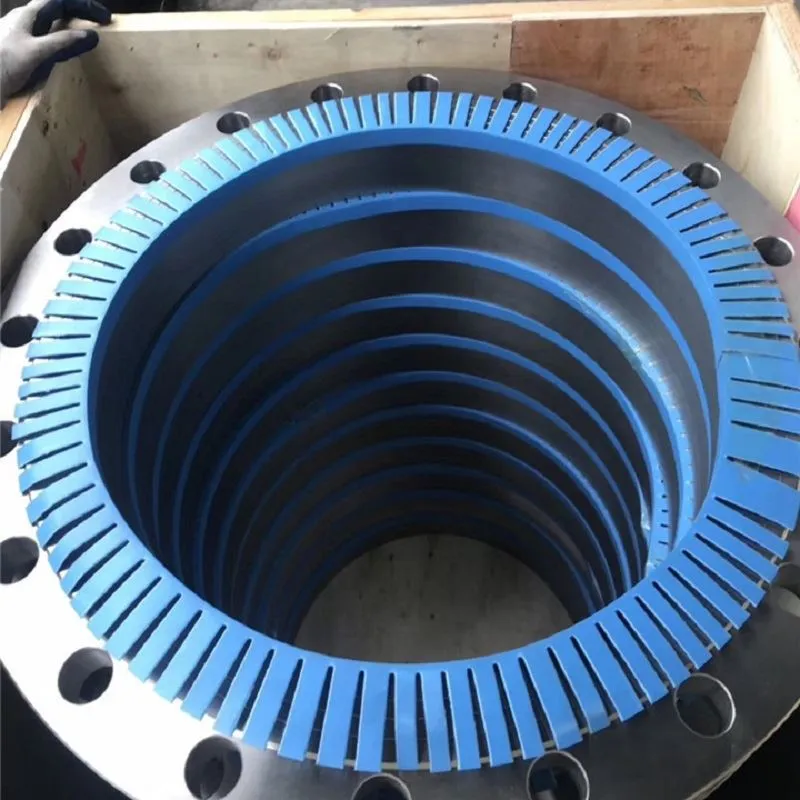
Another sore point is the quality of the sealing surface treatment. For class 600, the RF (Raised Face) or RTJ (Ring Type Joint) design is most often used. The surface roughness must strictly meet the standard (usually 125 to 250 microinches for RF). Surface too smooth? The gasket will slide and squeeze out under pressure. Too rough? The gasket will not fill the microchannels and leakage will occur.
I've heard stories of site installers simply grinding flanges with a grinder to "fit" them. This is a crime against engineering. The surface must be processed with a special tool that creates spiral grooves. Visually this is immediately visible. No spirals - no tightness.
This is especially true for ring flanges (RTJ). The groove for the ring must be perfect. Any scratch along the groove is a path for high-pressure gas or oil to leak. In 2026, the requirements of supervisory authorities became more stringent. Acceptance of such units has become stricter. Do not risk the reputation of the project in order to save a couple of thousand rubles on a batch of flanges.
Price analytics: what to expect in 2026?
Let's move on to the most painful part - money. Predicting prices in Russia is a thankless task, but certain trends can be clearly seen. Costflanges ASME class 600from the plant in 2026 will depend on three variables: connection type, diameter and steel grade.
There is an increase in prices for stainless flanges (A182 F304, F316). This is due to the rise in price of nickel and molybdenum on world exchanges. Carbon flanges (A105) grow more slowly, but energy costs for forge shops play a role here. Gas and electricity are becoming more expensive, and factories are passing these costs on to the buyer.
What does "from the factory" mean? Many companies write “manufacturer”, but they themselves are ordinary trading houses that order products from third-party facilities and put on their nameplate. How to distinguish a real manufacturer? Ask for a production video. Not a commercial with beautiful music, but a live video of the workshop, where you can see the forging or machining process of your particular batch. If they start to fuss, there is a mediator in front of you.
This is where it is important to make a note about the geography of production. When we talk about reliable Asian suppliers capable of providing the full cycle from melting to finishing, we cannot fail to mention the industrial cluster in Dingxiang County, Shanxi Province (PRC). This region has historically been a key center for forging and pressing production in China. Enterprises such as Shanxi Hongkai Forging LLC, a company that operates three of its own vertically integrated production sites, are based here. Such factories are distinguished by the fact that they control every stage: from incoming inspection of raw materials and forging to heat treatment, machining and packaging. Having such manufacturers' own right to import-export operations eliminates unnecessary intermediaries, ensuring transparency of the transaction and the possibility of direct dialogue with plant engineers, and not with managers of trading houses.
Actual price range (approximately, excluding VAT, at the beginning of 2026):
- Flat welded flange (Slip-On) DN50 Class 600 A105: from 2,500 to 4,000 rubles.
- Weld Neck flange DN50 Class 600 A105: from 4,500 to 7,000 rubles.
- Butt weld flange DN100 Class 600 A105: from 12,000 to 18,000 rubles.
- Stainless steel analogs will cost 3-5 times more.
Note the spread. Why is he so big? Because at the lower end there are often hidden products from small workshops with simplified control, and at the upper end there are branded factories with a full package of documentation and a guarantee. For critical facilities, a savings of 20% can result in millions in losses in the event of an accident.
Hidden costs that managers are silent about
The price per piece is just the tip of the iceberg. What else needs to be included in the estimate?
First, delivery. Class 600 flanges are heavy. Logistics to remote deposits can cost more than the metal itself. Secondly, incoming control. You won't install flanges blindly, will you? Budget for the services of an independent laboratory or your own quality control department to check geometry and hardness. Thirdly, fasteners. A Class 600 flange requires studs and nuts of the appropriate strength grade (typically ASTM A193 B7/A194 2H). They often forget about this, and then search for compatible fasteners urgently and expensively.
Comparison table: Factory vs Reseller vs Import
To make it easier for you to make a decision, I have compiled a comparative table of the main risks and advantages of different delivery channels in the current realities of 2026.
| Criterion | Direct order from a Russian factory | Large trading house (warehouse) | Import (China/India/Türkiye) |
|---|---|---|---|
| Price | Medium, transparent | High (markup 30-50%) | Low to start, but risks of hidden costs |
| Delivery times | From 2 to 6 weeks (on order) | Availability (1-3 days) | From 2 to 5 months + customs |
| Quality control | High, possible to travel to production | Depends on the conscience of the seller, often formal | Difficult to control, high defect rate |
| Documentation | Full package (certificates, passports) | Copies, sometimes with errors | Problems with the legalization of certificates in the Russian Federation |
| Warranty | Real, written in the contract | Often limited to return of goods | Virtually absent |
| Risk of counterfeit | Minimum | Medium | High (substitution of steel grades) |
As you can see, a direct contract with the plant looks like the most balanced option for serious projects, despite the waiting period. The warehouse is only good for emergency situations when the pipe is leaking “right now.” Importing in 2026 has become a lottery: you can win on price, but lose on quality and timing. However, if you choose the import route, it is critical to choose partners with their own infrastructure, such as the large clusters mentioned above in Shanxi Province, where a multi-level quality control system is implemented at all stages - from physical and chemical testing of raw materials to the final geometry check.
How not to buy a “pig in a poke”: acceptance checklist
Let's say you find a supplier, the price suits you, and the documents seem to be in order. What to do next? Don't relax. The moment of cargo acceptance is the last line of defense.
Here is my personal algorithm of actions, which I recommend to all chief engineers:
1. Visual inspection of packaging and labeling
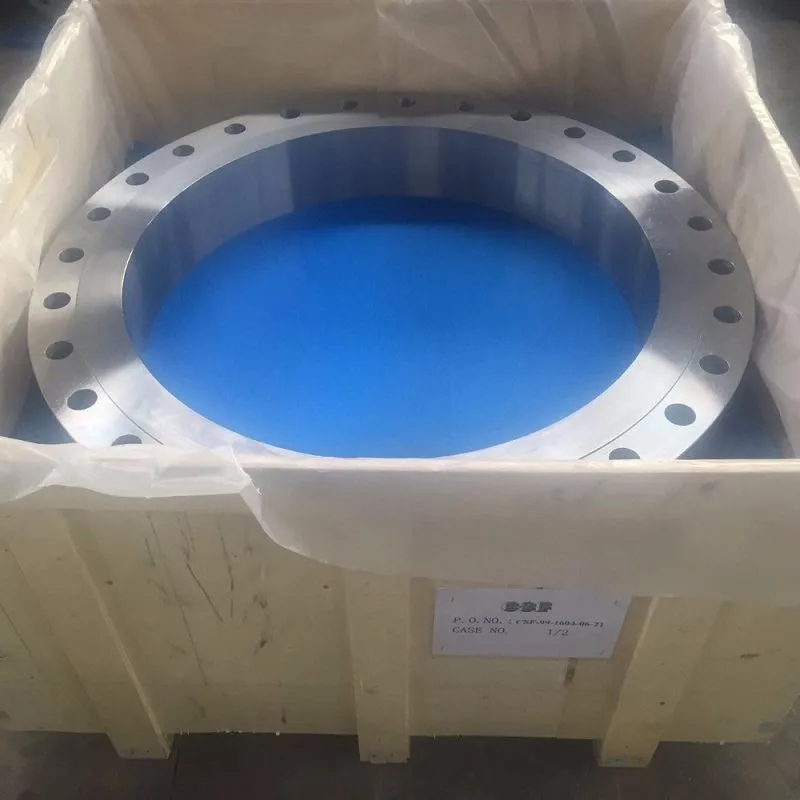
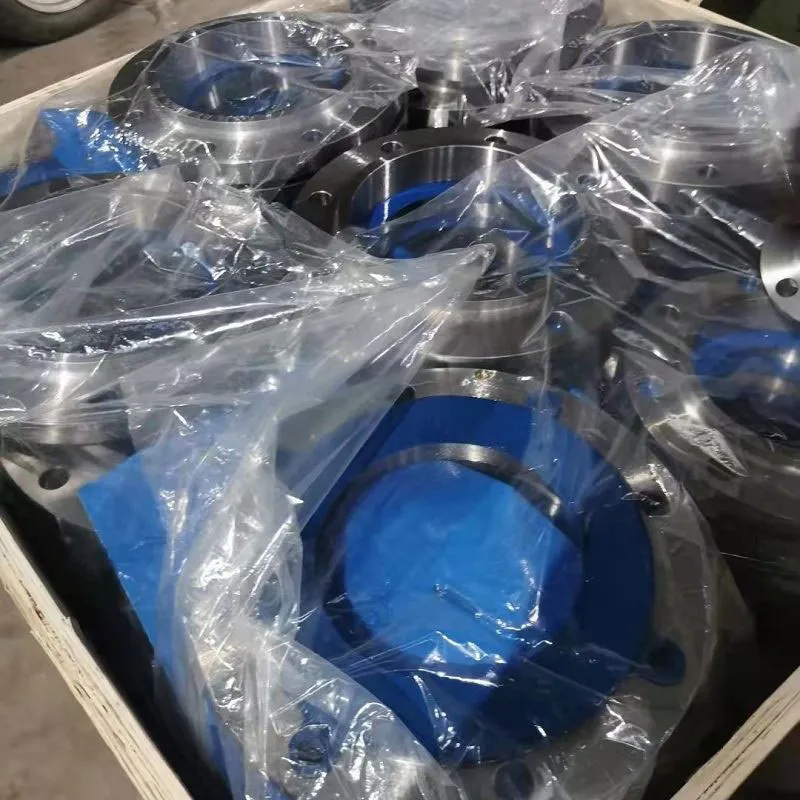
Flanges must be packaged in such a way as to prevent damage to the mating surfaces during transportation. Wooden boxes or sturdy pallets with dividers are a must. The marking must be applied with indelible paint or stamped. Check the conformity of the designations: size (NPS), pressure class (Class 600), material grade (for example, A105), heat number. If the heat number is missing, this is a cause for serious concern. Without a heat number, it is impossible to trace the history of the metal.
2. Geometric control
Take a caliper and check the main dimensions: outside diameter, bolt circle diameter, flange thickness, flange height. Tolerances according to ASME B16.5 are quite strict. Deviation of the flange thickness to a smaller direction is unacceptable - this is a direct reduction in strength. Check the perpendicularity of the flange end to the pipe axis. A crooked flange will create stress in the pipeline, which will eventually lead to fatigue failure of the weld.
3. Hardness test
This is a simple test that can be done directly in the warehouse with a portable hardness tester. Hardness must meet the standard requirements for a given steel grade. Metal that is too soft means a violation of heat treatment. Too hard - risk of brittle fracture. Compare the readings with the data on the quality certificate. A discrepancy of more than 10-15 HB units should alert you.
4. Analysis of the quality certificate
Don't just look at the print. Read the numbers. The chemical composition must fully comply with the ASTM standard. Pay special attention to the content of sulfur and phosphorus - harmful impurities. Their content should be minimal (usually less than 0.035%). Look at the mechanical test results: yield strength, tensile strength, elongation. If the numbers are “round” or suspiciously close to the minimum standard values, ask for clarification or an independent examination.
Localization and service: Russian context
Why do I insist on working with local manufacturers or official representatives? Service. There are huge distances in Russia. If after six months of operation it turns out that a batch of flanges has a hidden defect (for example, a tendency to intergranular corrosion), you will need to resolve the issue of replacement. With a Chinese factory that does not have an office in Moscow or Yekaterinburg, this will turn into a nightmare of correspondence in English and denial of any responsibility.
Russian factories operating according to ASME standards have already learned how to do quality work. Yes, they still have problems with party stability, but they are here, they are in touch, and they value their reputation within the country. Many of them have been audited by large oil and gas companies and have the necessary approvals from Rostekhnadzor (although this is not always necessary for ASME, but it does indicate the level of control).
It is also worth mentioning climate adaptation. Russian manufacturers better understand the specifics of equipment operation at minus 60 degrees. They can offer steel modifications or additional requirements for impact strength (Charpy V-notch test) at low temperatures, which is critical for northern regions. Imported flanges made for the Southeast Asian climate may not pass the Siberian winter test unless the customer explicitly states these requirements in the specification.
Future of the market: forecasts and concerns
What awaits us at the end of 2026 and beyond? I see several trends that could change the balance of power.
First, consolidation. Small forges that are unable to provide the proper level of quality control and documentary support will be washed out of the market by large orders. There will remain players capable of providing a full range of services: from melting to finishing and painting. It is precisely these companies, with a wide range (from DN15 to DN4000) and working according to DIN, ANSI, ASME and GB standards, that will be able to satisfy the requirements of both compact technical solutions and large-scale industrial projects.
Secondly, digitalization of passports. I expect the introduction of product tracking systems via QR codes or blockchain, where the entire history of the product will be protected: from the slab number to the name of the quality control inspector. This will make life more difficult for counterfeiters. Already, some leading factories are implementing such systems.
Thirdly, the growing demand for special alloys. With the development of hydrogen energy and the complication of oil refining processes, the need for flanges made of special alloys (duplex, super-duplex, Inconel) will increase. It is difficult to produce them, there is little technology, so the price of such products will only increase. For those planning projects using such materials, I recommend concluding long-term contracts with a fixed price now.
There is also an alarm bell. Shortage of qualified personnel at factories. Old technologists are leaving, young people are not coming. This may lead to a decrease in production standards in the medium term. The human factor remains the weakest link. Even the most modern equipment will not save you if the operator forgot to set the correct heating mode.
Conclusion: final verdict
Purchaseflanges ASME class 600in 2026, this is not just a money-to-goods transaction. This is an investment in the security of your facility. Saving on this element of the pipeline is false and dangerous. The cost of repairs or installation downtime due to a leak on the flange is not commensurate with the cost of the product itself.
My advice is simple: work directly with trusted factories that have a reference list in your industry. Don't chase the lowest price on the market - miracles don't happen. Demand full transparency of documentation and conduct incoming inspections. Remember that a Class 600 flange holds pressure that is unforgiving.
The market is changing, new players are appearing, but the fundamental laws of physics and physical strength remain unchanged. Steel is steel. And it either meets the standard or it doesn’t. There is no third option. Choose those who understand this and are ready to answer for their products with their heads, and not just with their signature on the invoice. Whether it is a Russian manufacturer or a large international player with its own workshops in the industrial centers of China, the main thing is the presence of a full production cycle and the possibility of personal audit.
If you are faced with choosing a supplier right now, ask him one question: “Can I come to your shop tomorrow and see how my batch is forged?” The answer will tell you more than any beautiful booklet. Good luck in building reliable highways!